Guide | Understand and compare
3 to 2 Nap Transition: Compare Two-Nap and Three-Nap Days
The move from three naps to two is best considered as a pattern across days: what happens to the third nap, how earlier naps fit, and how the afternoon and bedtime go. One refused nap is not enough to decide. Here is what to observe and how to compare the evening.
By Baby Sleep Tools · About our content
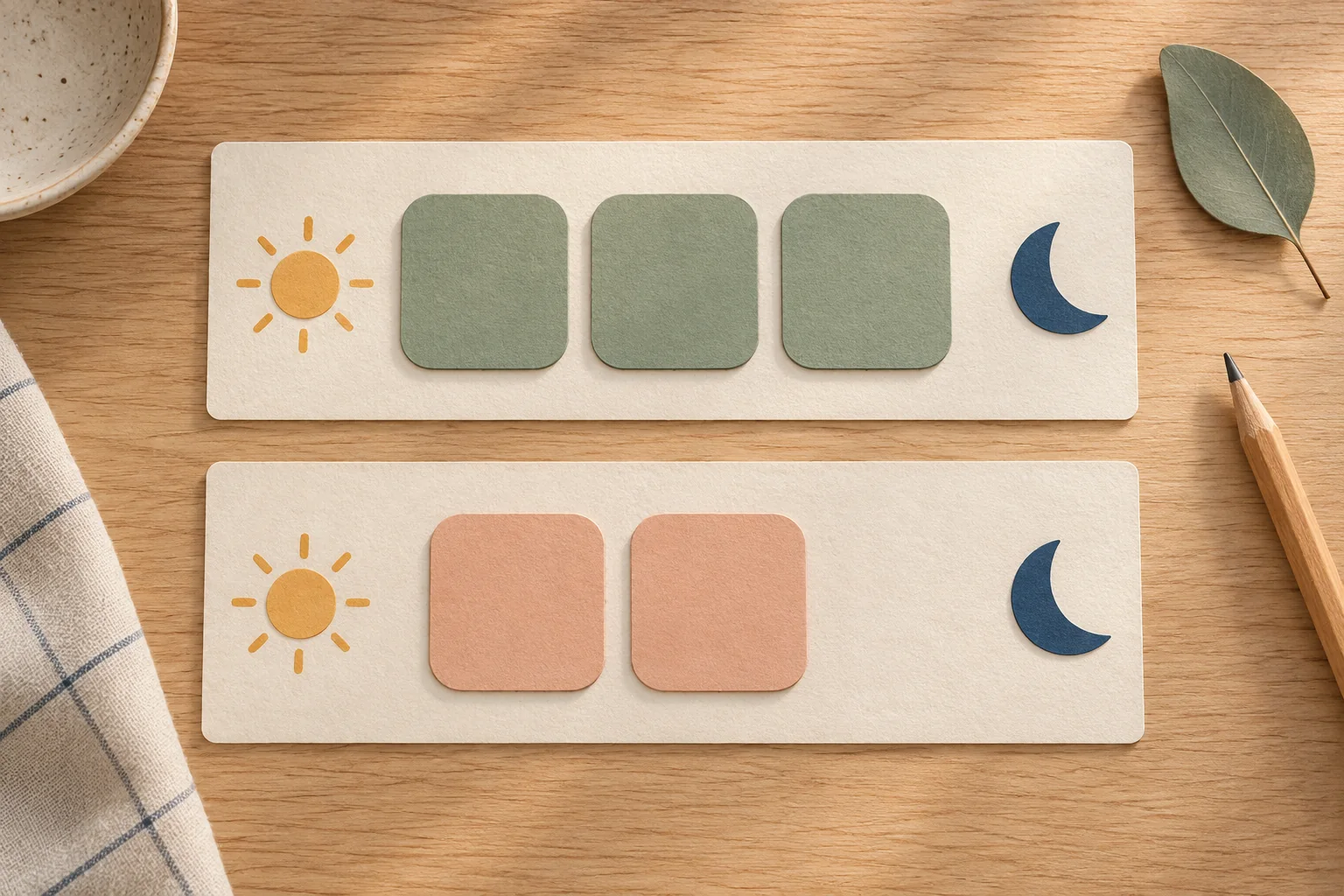
When does the move from three naps to two happen?
There is no birthday that makes a third nap unnecessary. General pediatric guidance describes a period when two- and three-nap patterns both occur. A transition is a change in the pattern of the whole day, not simply a single refused nap.
Nemours describes two to three naps during later infancy, while Mayo Clinic discusses a late-afternoon nap that may eventually fall away. Neither source supplies a readiness test for your individual baby. The useful question is whether the current arrangement still fits repeated real days.
Further reading: Nemours KidsHealth: Naps · Mayo Clinic: Baby naps
Which signs are worth looking at together?
Compare these observations: whether the third nap is repeatedly attempted but does not happen; whether earlier naps are taking up more of the day; whether a late nap and the usual bedtime regularly compete for the same time; and how your baby is doing in the afternoon. These are questions to review, not a validated checklist or a score.
Write down what else changed, such as a different caregiver, an outing or an unsettled day. One missed opportunity has a different meaning from repeated failed attempts in an otherwise familiar routine. Keep a successful third nap in your notes too, so the comparison does not include only difficult days.
Continued sleepiness or difficulty getting through the afternoon is a reason to pause the assumption that fewer naps will help. Review the whole pattern with your care professional if you are uncertain; do not stretch awake time just to produce a two-nap record.
How should bedtime change during a transition?
Start from the final nap that actually happened and keep the familiar wind-down routine. Removing a planned third nap changes the remaining day, but does not automatically give a correct new bedtime. Compare the evening from the last known wake, not from the wake time you hoped for.
If an earlier evening is an option you already use, compare it with your usual plan and note any family commitments. If a third nap does happen, update the facts before looking at bedtime again. Some days may look different while you work out a sustainable routine.
The two structures below make those assumptions visible. They do not instruct you to skip sleep, cap a nap or change feeds. For a third nap missed today, the linked missed-nap guide provides the immediate recording and evening-planning steps.
Further reading: NHS: Helping your baby to sleep
Start from an example
Example — nothing has been recorded. Read these structures without entering anything. No default sleep times or age recommendation are supplied.
Three-nap structure
| Step | Assumption |
|---|---|
| Wake | The same chosen starting point |
| Nap 1 | Your interval, then your assumed nap duration |
| Nap 2 | Your interval, then your assumed nap duration |
| Nap 3 | Your interval, then your assumed nap duration |
| Bedtime range | Your interval after the final assumed nap |
The nap count is a comparison option, not a recommendation to change your day.
Two-nap structure
| Step | Assumption |
|---|---|
| Wake | The same chosen starting point |
| Nap 1 | Your interval, then your assumed nap duration |
| Nap 2 | Your interval, then your assumed nap duration |
| Bedtime range | Your interval after the final assumed nap |
The nap count is a comparison option, not a recommendation to change your day.
What you explicitly entered as having happened.
A future assumption. Never added to recorded sleep.
A range of possible times. Unknown stays unknown.
Compare these structures using my own parameters
Structure templates v1 · no numerical age template approved. You can also start from what happened without choosing an example.
Start with the question you are trying to answer
Today’s missed third nap and a longer-term change of pattern are different questions. For today, record whether the nap was tried without sleep or not offered. For a broader discussion, organize what you have observed across days rather than treating one difficult afternoon as a decision.
Keeping your current arrangement and continuing to observe are valid options. There is no countdown, readiness score or winning plan here. Discuss persistent difficulties or health concerns with your care professional.
Compare the same assumptions
The two structures below use the same starting wake and the same interval and nap-duration ranges that you enter. One includes three assumed naps and the other includes two. Their diagrams use one shared scale, so a shorter drawing cannot make one option appear better.
Read what changes and what remains unknown: these are planned sleeps, not a prediction that the baby will sleep at those times. The arithmetic also does not decide whether the same interval is appropriate under both arrangements. Change your assumptions only for reasons outside this comparison, such as a care plan you already follow.
If the third nap did not happen today
Do not remove an actual nap that did happen to make your record resemble the two-nap example. An unsuccessful attempt and an unoffered nap are separate events; neither adds sleep. Open the missed-nap guide to choose the right entry, then compare tonight from the latest known wake.
A possible later nap stays a plan until it happens. The tool does not automatically shorten sleep, add a bridge nap or change feeding to satisfy a preferred bedtime.
Carry only useful assumptions into your day
Use this as a starting point copies an option’s interval, nap count and duration into a settings draft. It does not copy the example wake, its date, its age, or any planned sleep into your actual record. Review the remaining nap count before applying the draft.
A new comparison never replaces the active plan until you choose Use this plan. If an actual entry changes, the older plan is marked for review. A saved snapshot keeps the version and generation time so another caregiver can tell that it is not live.
Questions about comparing nap counts
Will this tell me that my baby is ready for two naps? No. It displays the consequences of assumptions you enter, not a readiness diagnosis.
Must I use the two-nap option after comparing it? No. Viewing an option changes no records and selects no winner.
Why are there no default example times? No numerical age template has been approved for this version. You can read the structures or supply your own parameters without treating test values as advice.
What you explicitly entered as having happened.
A future assumption. Never added to recorded sleep.
A range of possible times. Unknown stays unknown.
Recorded: Your entered events stay in place. An explicit edit changes only that entry.
Future times depend on the current facts and your settings.
Future times depend on the current facts and your settings.
Plan starts from the current information. Select a comparison only after reviewing it.
Continue with what happened
Was this useful for your situation?
Sources and scope
- NHS: Helping your baby to sleep
- American Academy of Pediatrics: Getting Your Baby to Sleep
- Nemours KidsHealth: Naps
- Mayo Clinic: Baby naps
These sources provide general care context. The structures, comparison interface and arithmetic are this site’s own design; the sources do not approve an individual interval or nap schedule.
Version three-to-two-v2 · Editorial source check: October 7, 2026. Numerical age examples and professional review are not approved in this release. No medical review is claimed.
Read the calculation method